Sunday, September 27, 2015

When Crisis meets Grace -- a Heartbeat for Europe

Hungry, tired, weak and traumatized ... everyday 8,000 more desperate souls hobble across borders into makeshift refugee camps, struggling for a chance at security, searching for hope.  An estimated half million have staggered into Europe so far in 2015, the women peeking from beneath the head scarves of their Muslim faith, wondering if today they will eat, speculating if their little ones will survive, perhaps questioning if Allah even cares about their desperate journey.

This is Europe today. And UNHCR says it is likely just the "tip of the iceberg" of what's coming.

And so the tsunami of humanity has brought with it a flood of fears of holy wars. Some speculate that ISIS is using the crisis to flood the West with its operatives who will be poised to embark on a rampage of unconscionable terror attacks at a strategic time. Others argue that by simply allowing such large numbers of Muslims into Europe, we set the stage for an "Islamicisation" of the continent within the next few generations. A victory for Muhammad without firing a single shot.

Crisis, indeed. And Europe may never again be the same.

But while many have wrapped themselves around the anxiety of certain annihilation, countless others, followers of Christ from varied backgrounds, have banned together in Hungary to, not just tell, but SHOW these needy refugees that there is a God in Heaven who loves them so completely that He sent his Son, Jesus, "Isa," to die that they might live.

"But what if there are terrorists among them?" you might ask. Then through the blankets and the bananas, the smiles, and the tears, just maybe a Muslim extremist might discover the difference between the god of jihad, and the God of Grace.

Arpad Horvath-Kavai worked with the ecclectic group of voluteers at the Hungary's southern border, handing out food packages and blankets and striving the meet the insurmountable needs. He wrote of the experience:

The extraordinary circumstances of the largest exodus of people since the last world war culminated in remarkable spiritual blessings—prayers were offered in the name of ʿĪsā,(Jesus) weary souls saw the light, the Scriptures were quoted, and Yahweh was praised.

Yes, the world faces a crisis in Europe. But instead of moaning and harping the worst possible case scenarios, we as Christian must realized that "our struggle is not against flesh and blood," (Eph. 6:12) and we must take the battle to our knees. This moment is more than the moment of crisis. It is the hour of opportunity.

Thousands, perhaps millions of Muslims, pouring into Europe know only the kind of god they've ever been exposed to:  a god of judgement, a god of  law.  Imagine if in this desperate time, they could be introduced to a God of Grace and the very real possibility of relationship with Him.

GoodSports International recognizes that the Word of God is the very heartbeat of relationship with Him. And in an effort to share this life, GoodSports is seeking to put an Arabic language Bible into the hand of every refugee, to make known this God of love, this God of grace, Isa (Jesus).

Join us in this battle and pray for all the migrants and refugees flooding into Europe. At the end of these trying days may we be able to stand against the Evil One and say what Joseph did in Genesis 50:20: "You intended to harm me, but God intended it for good to accomplish what is now being done, the saving of many lives."


[You can join the "Heartbeat" refugee Bible project by clicking here and donating under the item "GoodSports Hungary -- Refugee Ministry."]


Sunday, March 15, 2015

R.I.P. Rob Greathouse

R.I.P.  Rest in peace. These have become our trite words of release. An acronym of farewell that perhaps helps us let go of those we love who have made the journey into eternity. During this past week, our dear friend Rob Greathouse, who paved the way for us coming to Hungary in many ways, crossed over through death into life eternal. And as his passing has caused me to remember the past and recall his great contribution to ministry here in Hungary, I find the old acronym RIP, strangely inappropriate.

Rob and his delightful wife, Carol, came to Hungary several years before my family did. Carol was the extrovert with a heart full of compassion and such extraordinary love for everyone. Rob played the role of the strong stoic background man, the homebody that held down the fort. Together they were truly a force to be reckoned with, a force that no doubt left Satan shakin' in his shoes. They hosted orphanage kids for special weekends away from the institution. They played a critical role in building the church that we all know as Golgota Debrecen (Calvary Chapel, Debrecen).

Carol was larger than life, calling everyone "honey bunny" and leaving all with the sense that they had a loving and compassionate Grandma in their court.  Rob always proved understated. Saying little and at times coming across as a bit prickly.  But his prickles were just a thin veneer that never successfully hid his GIANT heart.  Generosity was second nature to him, and his giving was always without pomp and circumstance. He saw a need. He met the need. And that was that.  The masses would never know he was involved.

After 10 years in Hungary, they decided it was time to return to the states. But before they left Hungary, they received news that fell like a bombshell. Rob had cancer and he likely would not survive three months.  By the time they sold their house and he climbed aboard the plane, pain racked his body to such an extent that he doubted he would even survive the flight home. But then something remarkable happened.

When he got back to the states all the cancer disappeared. God had given this older couple a gift. They would be able to enjoy the treasure of each other for several more years. And enjoy it they did!  A marriage rekindled with a renewed love, deeper than either of them thought possible. It was restoration. It was love. It was life at its best.  But it was also on a timeclock. Last year the cancer returned, and as the months passed, it became increasingly clear that this cancer would be terminal.

About a month ago they visited the oncologist as they prepared to go into hospice. The doctor explained the process. Rob would receive medication for pain so he should not suffer. His body would grow increasingly weak and he would find himself sleeping more and more often until finally he would simply not wake up. And it would all probably conclude within a month's time. Rob left the meeting elated.

"Wow! That's great news!" he said. "I get to be with Christ in Heaven within the month, and I don't even have to suffer. I get to go in my sleep!"

And so it happened much as the oncologist described.  The final weeks were speckled with indescribable moments of family affection, sparks of Rob's unwavering humor, giggles and smiles alongside tears and aches until finally last week Rob slipped into that final sleep.

Rest in peace?  No, that's not for Rob. Rest is for the weary.  Rest is what Rob needed as the pushed forward in life under the weight of human frailty in those final days.  Rest is for those who walked this road at his side and now fall exhausted under the strain of what they've come through. For Carol and family I pray they will experience the "rest" of Hebrews 4 in all its fullness, and that includes the comfort and assurance of knowing where Rob lives right now.

But rest is no longer for Rob. Rob shed that heavy, faded cloak of human flesh last week, and when he did, he emerged with zeal and energy into the incomprehensible and boundless love of Christ. Basking in the glory of Lord, Rob is not wanting to rest.  For him, now is the time to revel!

And so I do not say, "Rob Greathouse, Rest in Peace," because I know there's a heck of a lot more to the hereafter than slumber.  Heaven is a place of exuberance where we come into the fullness of who we are because we have been made complete by Christ on every level. To be in the very presence of Christ, face-to-face, who could rest?  Every fiber of Rob's being must be rattled with excitement.

Considering that, maybe I can still say R.I.P. But by those letters I do not mean "rest in peace."  I mean something far more significant.  So go ahead, Rob Greathouse, go ahead and revel.  R.I.P. "Revel in His Presence!" We will join you soon!


Monday, January 19, 2015

Growing Pains: Did you really think there wouldn't be a cost?


That day when you sent me out so boldly to change the world, did you really think there wouldn't be a cost?” --Martin Luther in the movie “Luther”

When we enter Christian service on any level, we'd be terribly naive to believe there will be no cost. Any perusal of scripture leaves no doubt, “To this you were called, because Christ suffered for you, leaving you an example, that you should follow in his steps,” 1 Peter 2:21 explains. But so often the cost proves very different from what we brace ourselves for.

I recently read of blog about how missionaries can never go home again. They are truly strangers and aliens when they go home on furlough as they return to a world that is no longer their own. Friends and family members' lives have moved on. They find they no longer really fit in. So “going home” is really not going home at all. Back in the country where they serve, they find they can never fully fit in either. They are always a little behind the power curve. In one way it has become home; in another, they find they remain just another foreigner. And so we, as missionaries, are truly strangers in a strange land wherever we go. It is cost that comes with the territory.

I have largely learned to just accept it. It is a price that must be paid to have the privilege of living an extraordinary experience in the plan of God for this world. And it is very worth it. The alternative of just remaining hunkered down in one spot never understanding that people see the world differently, to me, is completely unthinkable.

But lately, this cost has erupted with new significance for me. Everyone thinks about the sacrifices missionaries make when the leave their home country for the mission field. Few give thought to the pain involved when circumstances require missionaries to leave the mission field they so desperately love to go “home.”

America is not home anymore for me. Mikepercs, Hungary is home with all its roosters crowing in the middle of the night, the dogs barking, and the smell of coal thickening the winter air. The horse-and-wagons rumbling down the street outside our house still make me smile as do the sounds of the village festivals melding the croaking frogs in the midsummer's twilight.

And yet, circumstances beyond our control, confirmed by affirmation from above (that I really did not want to listen to), have made it clear that in this next year we will be returning to the states.

In a lot of ways for us, it is like moving to a mysterious foreign country. The USA has changed so much since we lived there some 15 years ago. Technology has evolved. I don't even know how to pay bills in America anymore. I feel awkward and ignorant when I am in the states. I still feel that way in Hungary sometimes, but people understand that here. I am a foreigner!

I don't know how to use a smart phone! I've forgotten that gas comes in gallons, and how much is gallon, anyway? Miles instead of kilometers. Pounds instead of kilograms. No one walks anywhere. Public transportation is scarce. Food tastes funny because of all the preservatives. I am already culture shocking and we haven't even left yet!

Once again we find ourselves strangers in a strange land. And it is scary, scarier than when we came to Hungary, because we have three teenagers to shepherd through the radical change – three kids who know little about American life and culture.

When watching the movie “Luther” the other night, one quote stood out to me. As Luther's views began to shake up the establishment, he was confronted by his early mentor. Luther responded, “Did you really think there wouldn't be a cost?” It echoed in the recesses of my spirit.

Yes, I thought there would be a cost, but I didn't count on it being this one. It hurts to lose Hungary and the remarkable people I have come to know and love here. The things they have taught me shall be treasured in my heart for decades to come. They have made me into the person I am. Hungary has changed me, and I cannot imagine my life without this precious place.

And still we must go. Through the ache and with a heavy sigh, we will have to move forward and again become “strangers and aliens” because we indeed are not of this world.

No, moving to Texas is not going home. The only real home will not be found here in the “puszta” of Hungary or there on the plains of Texas. The only true home will be found in the Heavenly hereafter.

This perpetual sense of loss and feeling of homelessness is all part of the cost. And although the cost is high, I'd suffer the ache again and again. Because at the end of this life, I know the pain will not prove pointless. It will prove to have been what's necessary to grow into what I needed to be. 

It's just
growing pains.

Tuesday, November 18, 2014

Recovering Thankfulness by shattering the lens of "me"

In America, the Thanksgiving season has arrived with all the splendor (and chill) of autumn. And while we ponder pumpkin pie and smoked turkey, it's a good season to think a little about what thankfulness really is.

"Thank you!" If you were raised to be polite, you probably say that a lot. When you make a purchase at the store, you say, "Thank you. Bye," as you leave. But is that really thankfulness?  Do you sincerely feel that sense of appreciation that comes from thankfulness. Probably not. Why? Because, you paid for the item. You simply got what you deserved.

BUT if you went to pay for an item and clerk said, "I tell you what, I am going to pay for that, myself. You can have it for free," your attitude would be different. Some of us would try not to accept it. "No. no, you can't do that. I must pay for my things."  Others might take a step back dumbfounded.  But at the end of the transaction, most of us would say, "Wow, thank you."  Same words. Totally different sentiment, a sentiment of true thankfulness.

I fear we have largely lost the sentiment of true thankfulness in our modern lives. We have more stuff and likely live in nicer houses than our parents' generation, certainly more than our grandparents'. We have all the gadgets of our technological age. We have dishwashers, clothes washers, even clothes driers! We live in an age of jet airplanes and regular vacations.  We have more to be thankful for and yet, ironically, we've largely lost the sentiment of thankfulness.

Baby boomers became known as the "me" generation, bent on "self-realization and self fulfillment."  Now the millennials are becoming known as the "me, me, me," generation, marked by overconfidence, sense of entitlement and laziness. The me culture has become our norm and it has even impacted our Christianity.

Perhaps here is where we find our fundamental flaw.  We only see the world through the lens of ME.  Psychologists of our times speak of  people suffering from everything from inferiority complexes to superiority complexes, or vacillating between the two. Yet all the complexes place the "me" at the center of the universe.

And when we can only see the world with the "me" at the center, we are incapable of comprehending the truth of who we are and who God is.  Until we "get" this, it's hard to truly be thankful.

I was recently reminded of one of my favorite stories of the Bible. Matt. 15:26 tells of a gentile woman who came to Jesus in utter desperation because her child was tormented by a demon. For many it is a troubling story because of what Jesus says to her: "It is not good to take the children's bread and throw it to the dogs."(v.26).

Stinging words! But surprisingly, this woman was not offended at all. Why? Because she knew it was true. The woman understood exactly what He was saying. Jesus was calling things as they are. She had no right to ask anything of Jesus. She was not even a Jew, for heaven's sake!

She could demand nothing. She knew she was like a dog, the pet that lies beneath the table. She accepted that, because she was not looking at the world through the lens of "me".  As a result, she could see things as they were. She understood exactly who she was and who He was.  Because of this understanding, she made an appeal. "Yes, Lord; but even the dogs feed on the crumbs which fall from their masters' table," she said. (v27).

It was a remarkable moment. It brings tears to my eyes, as it must of done for Christ himself as he answers with great emotion, "O woman, your faith is great; it shall be done for you as you wish."(v. 28).

So while God's own chosen people were rejecting him, the Jewish leaders were fighting with him and his own disciples were so often missing the point, this pagan woman really understood who God was and who she was. And on that basis, she made her appeal, an appeal for mercy, for grace. And when she received that which she asked for, we can be sure her heart brimmed with true thanksgiving.

As we enter this thanksgiving season, let's take the time to step back from all our luxuries, remove the lens of "me" and just see God for who He is.  When we let Him truly be the center of our universe, we can begin to understand who we are in the face of His reality.  And then, perhaps, we can recover a true spirit of Thanksgiving.

Monday, November 17, 2014

This blog has been dead for the past year, mainly due to a huge writing project that's now complete.  My newest book, "A Story of Grace: Beyond the Iron Curtain" is now available on Amazon.com. Written with Phil Metzger, pastor of Calvary Chapel Budapest, this book looks at some of God's amazing works in Central Europe over the past twenty years. http://www.amazon.com/Story-Grace-Beyond-Iron-Curtain/dp/0578143062
I look forward to returning the world of blogging soon.

Monday, April 21, 2014

Easter Saturday: Doubting God

Nestled between the tragic "Good Friday" and triumphant "Easter Sunday" lies a day often overlooked in the Christian calendar: Easter Saturday.

It's a day sometimes observed by the more high church denominations with ceremony and tradition, a day of mourning. It's a day of grief.  But it is also a day of much deeper emotion, a day that represents doubt and despondency.  And it poses a poignant question: How would you respond if everything you could see, hear, touch, feel, and taste told you that what you've believed in was completely wrong.

On Friday, the disciples, family and followers all watched Christ die a gruesome death.  Perhaps even as they stood there, against all hope, believing God would intervene at the last possible moment and all would see that Jesus is Messiah!  But God didn't intervene. God let Him die.

For those who believed in Him so completely, it had to have been incomprehensible. They knew Him and loved Him. He could not be dead! He had not done what Messiah was supposed to do! He had not ushered in a new era.

And yet as they wrapped his body quickly in spices and laid it in the tomb, they faced the incomprehensible reality.  He really was dead. As they pushed the stone over the cave opening, they had to begin burying all the hopes and dreams they had wrapped up in Him as Messiah. It was over.

As the sun rose on Easter Saturday, they had to go through their Sabbath routine, but it had to have felt so empty.  The questions must have screamed through everyone's mind, even if no one dared utter the words aloud.

Had Jesus deceived them? The love they had for Him made the possibility all the more painful to consider.

Was He not the Christ? How could He be if now He were dead?!

But His love, His miracles!  And yet now, He lay dead in a tomb. Death did not lie.

All evidence, all reality, all of life experience culminating in the day of Easter Saturday left no doubt. They were wrong. They had clearly misplaced their faith.

We all have Easter Saturdays in our lives.  They do not always correspond with the calendar holiday, but they are there--days when we doubt, days when we wonder where God is and if He even really cares. And our harsh circumstances testify with all certainty that we've misplaced our faith by putting it in Someone we cannot see.

Easter Saturdays are critical, defining moments in our lives. They are moments when the rubber hits the road in our faith.  After all, what is faith but the "confidence in what we hope for and assurance about what we do not see." (Hebrews 11:1)  It's easy to have "faith" when God makes sense. But that's not really faith at all. But in those Easter Saturdays of our life, when all logic and circumstances scream "there is no God,"  that's when real faith begins.

Easter Saturdays are not the enemy of our faith. They stand as a necessary ingredient in establishing a true faith built on more than religious axioms and tradition.  Easter Saturday represents a critical part in the process that brings us from the point of inexplicable tragedy (Good Friday) to a place of complete redemption and hope (Easter Sunday), where faith actually does become sight.


Monday, December 24, 2012

Born To Die

It's Christmastime! The streets are ablaze with glittering lights as snowflakes dance in the early night air, and homes, schools, and shopping centers  burst with candy canes, caroles, and colorful gifts. In the hustle and bustle, the stress and expectations, Christmas can really become as artificial as the silver and gold tinsel on a plastic fir tree.

So much so that we become lost in all the gingerbread, chocolate, and childhood dreams of a fuzzy-faced icon in a red suit.

Yeah, yeah, we all know the true meaning of Christmas. And if you are at all like me, you struggle to keep it all straight this time of year. "No, no, it's not about the presents," I say to myself as I rush into TESCO. "It's about Jesus." But immediately the thought is lost among my lists of things to buy, cookies to make, meals to plan and prepare.

To be honest, I all but failed this year to stay spiritually on track during the chaos of Christmas; that is, until I went to Miskolc and visited the orphanage there on Saturday.

I've done the orphanage thing for many years. But this year was different. It was different because Marko wasn't there.

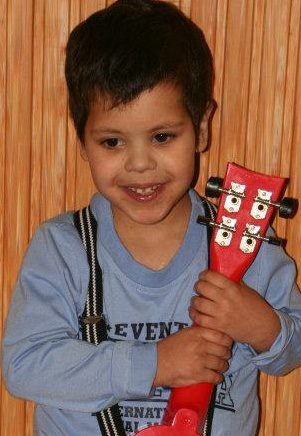
Marko, precious Marko, passed away at age eight last month.

I really hadn't thought about the void until I walked into the house where he used to live. As I passed through the door, I totally expected to hear his little voice cry out, "Szia, Trudy!" as it always had before. I did not even know I expected it, but it's cold, harsh absence hit me with a sober silence.  Sure, there were the sounds of the other kids laughing and playing, but Marko was not there, and I wanted to cry.

I pulled it together as the day's events continued, but a heaviness remained. At one point I saw Philip playing with one of the new little boys in his lap. I saw the little dark-haired boy wrestle and laugh out of the corner of my eye, and for half-a-second I believed it was Marko, at home in Philip's arms where he belonged. For half-a-second, I forgot. For half-a-second, everything was alright again.

Then reality hit. And all that was left was the ominous presence of Marko's all-too-painful absence.

This year has been a year of a lot of death. From young Ben's death of brain cancer to the suicide at the orphanage in the summer, to our friend who lost his father, to Marko, and the flower girl from our wedding.

Loss makes for a sobering Christmas. It pares back the superficiality and forces us to look deeper at the holiday -- to reach out (perhaps desperately) for something more.

And when we reach out for a deeper meaning in Christmas, we discover a baby born to die.

Indeed, there is no superficiality here. No tinsel, no sugar plums. Only the somber reality that, on some level, Christmas commemorates a life coming in the world with one fundamental goal, one purpose. And that purpose was death.

And it would be the most significant death the world had ever known, for all of human destiny hinged upon it. It was a death that would bring grief, just like you and I have known.  But it was also a death that ignited life eternal for all who dare ask.

That makes Christmas on one hand a holiday as sober as grief itself, and yet on the other, a true reason to sing, "Joy to the World! The Lord is Come!"

And so we celebrated Christmas at the Miskolc orphanage.  We handed out the gifts (provided by the generosity of the American military community in Germany) and it was fun to see the kids tear into them with all the eager anticipation that fills the season with magic.

So even if you are grieving this holiday season, you still have a place by the manger because the manger is not so far from the cross. And the cross is just a few steps away from the empty tomb.  And that's a reason to celebrate -- especially in a time of loss.


Friday, November 16, 2012

Unlikely Heroes of Faith

"Love ... always hopes ... always endures." 1 Corinthians 13:7

"It's over," the phone call came from Miskolc to Debrecen in a torrent of emotion.

 "Marko died this morning," the sms on my phone read.

It was a sober day for all of us. The fight for a precious life was over. The struggle had ended and now there was nothing left to do but ache and mourn.

 The doctors had said they had done all they could do for seven-year- old Marko back in the Spring. And at that time we all braced ourselves for the end, not expecting him to reach his eighth birthday. But the end did not come.

 And in those months that followed something remarkable happened. It was not the miracle we hoped and prayed for -- that Marko would be healed. But perhaps it was equally magical and mystical.

 It was a miracle that transformed an American football coach and his Hungarian girlfriend from mere volunteers at an orphanage into true "angels of mercy" or perhaps more significantly the loving parents of a rejected, sick and dying child.

It was a cross few of us would choose to take up. But it was the one put before Philip and Laura and neither hesitated for a moment. In fact, they likely would not have called it a "cross that they must bear" at all. It was a labor of love.

Each day they visited Marko at his hospital bedside, bringing odds and ends to make his situation a little more bearable. Loving him. Praying over him. Laughing with him on his better days and aching with him on his harder days. Celebrating the moments when he showed improvement. Always hoping that against the odds, that somehow, someway, this little boy's story could turn out differently than his diagnosis predicted.

They became Marko's parents in earnest, as if he were their very flesh and blood right through that critical moment when Marko slipped from Philip's big football player arms into the all-encompassing arms of his heavenly father. And because of Philip and Laura's love for him, he was prepared to understand the love of the heaven he entered.

Now Philip and Laura's arms are empty and their hearts bear the same void carried by all parents who have ever lost a child -- a scar that, as I understand it, may fade in intensity but never fully heals.

Although they would not call it such, they are true heroes of the faith.

 But there are no heroes without sacrifice. And there is no sacrifice without suffering. And unlike most parents who suffer such a loss, this suffering was not thrust upon them. They chose to take it up willingly when they vested their hearts into the waning life of a precious, orphaned child. They made that choice because they believed Marko was worth it.

Although our ache is not as intimate as Philip and Laura's, we do ache with them. And we stand inspired and awed at their demonstration of holy love, God's love, in the face of a difficult situation -- in the face of such a significant loss. But the loss is not as significant as the gain:

Marko may have lived as an orphan, but thanks to Philip and Laura, he died as a well-loved son.

Thursday, November 8, 2012

A Time to Grieve

This morning we lost Marko, the orphan who has been so sick for so long. No more pain, no more suffering, Marko now rests in the arms of his Heavenly Father. So much is wrapped up in this story on so many layers. But now it's time to put all that aside and take some time to grieve. In the face of all this, we do indeed have hope.

Tuesday, September 11, 2012

Just the Facts, Ma'am.

"Now faith is the substance of things hoped for, the evidence of things not seen." --Hebrews 11:1

It's September! And that means the misery of the summer heat has lifted and the kids are back at school! That also means I put my nose to the grindstone homeschooling one of my kids.


I must admit that my daughter (sweet kid that she is) challenges my patience and teaching skills to the limit, to put it nicely.  Her learning difficulties and short term memory issues coupled with her lighthearted, sanguine-phlegmatic personality sometimes make lessons an exercise in futility. 


I see her grasp the facts for a moment.  She can even use those facts to solve a problem.  Then suddenly ... POOF! They're gone, as evasive as a fresh breath of air in mid summer when you live next to a pig pen (which, by the way, we do).


And so we have to begin again. I have to get her to dig around her brain until she can find and reinstate the facts. Until the next time they manage to slip away.


Frustration, indeed!  But when I look back over a semester, I can see the improvement. Those facts that were so hard for her to hold onto at first, eventually settle in firmly, and she begins to recall them effortlessly.


But make no mistake. It is a long, painful process.


Recently I've been reading Watchman Nee's  The Normal Christian Life. It has caused me draw a parallel between the way my daughter learns and the way I learn spiritually.  


Nee talks about the simple facts of the Christian life that are so hard for us to maintain hold of.

Romans 6 outlines these facts:

1. the fact that our old self was crucified with Christ
2. the fact that we are dead to sin
3. the fact that if we died with Christ then we now live with/in Him.
4. the fact that because of these previous facts, we can now walk in newness of life.

Basic Christian facts, right?  And yet when was the last time we gave any thought to these facts?  We give a lot of thought to the facts of the material world: the fact of the family budget, the fact that the kids need new clothes, the fact that someone must cook dinner.  And granted, since we do live in this material world we have to deal with those facts too.


But I fear we tend to act like the facts of the material world are more "real" and "concrete" whereas the facts of the the spiritual realm seem only theoretical -- and somehow they fade from importance in the menial "real" tasks of daily life.  We may have used and applied those spiritual facts in the past, but like my daughter, we've allowed them to slip away from impacting what we are doing right now.


As a result, we become incapable of living the Christian life as we are called to live it. The key to regaining the perspective is "faith" as defined in Hebrews 11:1.  "Faith is the substance of things hoped for..." Nee explains that instead of substance, a better translation is "substantiation."  He says the word here describes something that is sort of like the relationship of color and the eye.  Color exists -- even though the blind man has never seen it.  The properly functioning eye provides us an ability to perceive color. It gives substance to the color so it can be perceived.


So also properly functioning faith in the Christian life enables us to perceive the world from the perspective of spiritual facts -- to see and understand things others cannot.


We as believers are called to hold on to the spiritual facts -- even when the facts of the material world seem more critical.


Today, even as I was writing this blog, my scatterbrained 11 year old declared, "I am going to focus and do this right!"  She suddenly took hold the facts and slowly and methodically used them to complete her on-line math quiz.


There were moments when the things of this world started to distract her: the smell of burning trash from next door, the sounds of people yelling outside, and the annoying yipes of our dog barking.  But she determined to pull herself back to the facts which enabled her to perceive and understand each math problem.  And then faith became sight as she earned 100 percent on the quiz -- and those don't come easy for her.


How important are the facts of Christianity to the hum-drum of our daily life?


 Oswald Chambers noted, "The things Jesus did were the most menial of everyday tasks, and this is an indication that it takes all of God’s power in me to accomplish even the most common tasks in His way. ...It takes God Almighty Incarnate in us to do the most menial duty as it ought to be done."


Try it and see. Take some time each morning to meditate on the spiritual facts of Romans 6 before you start your day. After all, we are exhorted in Romans 6:11 to "reckon yourself dead to sin and alive to God in Jesus Christ" so if we believe the Bible, there must be something to the act of focusing on these truths through the lens of faith.


Tuesday, August 14, 2012

Pressing on Even When it Hurts


"I press on toward to goal to win the prize for which God has called me heavenward in Jesus Christ." --Philippians 3:14

World Class Athletes.

I've watched in awe these past weeks to see phenomenal performances of young men and women in the 2012 Olympic Games. And part of the awe stems not simply from how they performed in London, but all the hours and years of training that led to this fateful occasion where they either medaled and watched proudly as their national flag fluttered to the rhythm of their national anthem. Or they headed home empty handed.

So much effort and training goes into becoming a world class athlete. Talent alone is not enough. Love for the sport alone does not cut it. I heard one interview which stated that these athletes often train 6-8 hours each day for years to prepare for the Olympic challenge. I am sure there have been many who had the talent, maybe even the love, but not the tenacity to make it to the Olympics.

Or perhaps its not simply that they did not have the tenacity. Perhaps they had other priorities in life. And quite honestly I can't fault them for that. I can certainly understand someone just saying, “It's not worth it to me. I'd rather invest in family or career or whatever with all that time.”

But as I watch Olympic athletes face their moment of truth, I find myself facing a moment of truth of my own. I can't help but think of what the Apostle Paul wrote in 1 Corinthians 9:27 when he compared the Christian life to that of an athlete in training. “I discipline my body like an athlete, training it to do what it should.”

Through the Holy Spirit, God has granted each of this the ability for spiritual victory. But it does not end there anymore that natural talent make an individual a world class athlete. We have to be willing to train.

Corrie Ten Boom's sister Betsy understood this truth when she lie dying in a Nazi concentration camp. She said: “Corrie, your whole life has been a training for what you are doing here in prison—and the work you will do afterward.”

We've faced a lot this year in GoodSports. If the year had a headline, it would be called our year of death. It started with a suicide at the orphanage in September, continued when our friend Ben Schoonover died of brain cancer in the Spring, culminated with a second apparent suicide at the orphanage in June, followed by the passing of the father of one of our baseball boys in late July. Even now, our dear little Marko from the orphanage suffers such severe health problems that we do not know if he will live to see his eighth birthday next month.

It's been a rough year, and yet somehow I know it is a year of training, training for the next step, the next phase of ministry and life.

And that's a little scary, because it just hurts so much. The hardest training hurts the most, but succeeds in making an athlete stronger, and preparing him for the victory.

To be honest, sometimes I just let myself get distracted from Him who trains me best. And maybe it's because I don't trust Him enough.

I fear the pain of training more than I long for the victory that grows from the deeper relationship with Him.

Are the sacrifices required to become a world class athlete worth it? That may well be up to the individual to decide.

But if we call ourselves “Christian” then we have allegedly “given our lives to Christ.” That means if we are truly Christian, we no longer get to decide if we want to train. We are in training PERIOD.

Sure, we can turn away. We can refuse to learn from our difficulties. We can ignore the Coach, but then we are blatantly choosing not to live the Christian life.

So maybe we just need to embrace the training and in doing so embrace the trainer who will take us to deeper relationship with Himself and fuller victory if we are simply willing “to press on toward the goal” especially when it hurts.

Tuesday, May 8, 2012

Praying in Whose Interest?

"For we do not know how to pray as we should..." Romans 8:26


Two children, two boys, two precious lives poised on the brink.
In the wake of Ben's death, my heart has been heavy as I ponder Marko and Gergely -- two little boys at the Miskolc orphanage with severe health issues.


The same week that Ben passed into the arms of his Savior, Marko underwent heart surgery.  And for a while, he wavered on the razor edge. We did not know if he would wake up. And in that moment, in the midst of the ache, I found it hard to see these two situations (Ben's passing and Marko's crisis) laid side by side.  


We were not created for death. It is a result of the fall.  And hence, we are ill equipped to deal with it. I guess that's why it hurts so much to lose someone you love, especially when they "go home early" as Ben did.


That's the way it is supposed to be.  It is supposed to full of ache and loss, that sense of emptiness and shattered dreams -- a future we imagined that will never be. 


But for an orphan child like Marko, there are no parents to fall asleep at his bedside, no one to ask all the right questions of the doctors. There's no one to create dreams for his future, and no one to mourn if those dreams shall never be.


Marko is doing as well as he could under the circumstances right now the doctors say.  But his condition is dire.  And unless God chooses to do a miracle, his life will be abbreviated.

And then there's Gergely.  He's about 8 or 9 but his body is the size and shape of a three or four year old.  I don't know exactly what his illness is, but I do know he will likely never reach adulthood.  And who will mourn him?

So how do we pray for such children? Shall we pray for miraculous healing? To what end?

For I have now seen several generations of kids grow up in the orphanage, and quite honestly, very few make it in the world.  Without parents to guide them and instill values in them, a harsh future awaits. It is as if they are set up to fail, poised for bad choices. Organized crime lies in wait to snare them. So much pain and hardship. I ache at the thought of it.

So then we should pray for miracle upon miracle, right? That God would not only heal these boys but also provide families, against all odds! For we are people of faith, right?

I have seen God work his wonders within the walls of that orphanage.  I've seen the unlikely placement of older kids into homes and even multiple sibling sets into families: situations that even the orphanage director called a miracle.  But I also understand that a miracle, by its very definition, does not happen everyday. Miracles would not be miracles if they were commonplace.

When we were praying for Ben, it all seemed so clear.  We would pray for miraculous healing, of course.  For Ben had the potential for an incredible future.  And yet, in doing so we now see that we were not necessarily praying according to God's interests, but rather according to our own emotions and sympathies.

So I come to the place of Romans 8:26, realizing I do not know how to pray. In fact, I tend to approach prayer all wrong.  Oswald Chambers explored the issue eloquently:

"We do not identify ourselves with God’s interests and concerns for others, and we get irritated with Him. Yet we are always ready with our own ideas, and our intercession becomes only the glorification of our own natural sympathies. We have to realize that the identification of Jesus with sin means a radical change of all of our sympathies and interests. Vicarious intercession means that we deliberately substitute God’s interests in others for our natural sympathy with them." 


But I don't usually bother with substituting God's interests for my own.  I'd rather pretend like my prayers are some sort of control mechanism I can wield at will. I want to be the author of people's life stories in my prayers. I want to tell God how work things together for good.  And let me tell you, I've given God a whole lot of advice over the years. And when He didn't take it I've tended throw temper tantrums, accusing Him of not answering my prayers.  What a spiritual brat I've been!

So how do I properly pray for Marko and Gergely?

I guess, I pray that God would accomplish his good plan in them. And because I know God enjoys our conversations, I can still tell Him that I'd love to see them healed and in  homes with families that love them.  But I also have to acknowledge it is not my place to dictate what God should do.  I know I do not see the big picture, and I do not know how their precious lives weave into the elaborate tapestry that is His plan for the world.  But I do believe they have a part in that tapestry.

And if God decides to take them home early, even though there will be no masses to mourn them and no parents to ache the loss, I will ache and mourn them.  But I will also know, that those who knew no father will at that moment know a father's love face to face.

Maybe learning to pray according to God's interests is what praying by the Spirit is all about.  It is giving up our own ideas, our own control and surrendering one more area of our life to Him.


Wednesday, April 25, 2012

To Live Like Ben Lived

"Follow my example as I follow the example of Christ." 1 Cor. 11:1

Two years ago I sat with friends expressing a zeal and hope for revival in their little Christian school.  They longed for spiritual renewal and prayed for it.  As I sat back enjoying their enthusiasm and vision, a thought popped in my mind: revival comes with a cost.

I really wasn't sure where the thought came from and I certainly did not voice it aloud. I didn't want to put a damper on such good fellowship and vision.  I locked the odd thought away and largely forgot about it.

Until a year later when I learned that a student in that school, a bright and shining young man of faith, Ben Schoonover, had been diagnosed with cancer. My heart sunk and my mind wandered back to that strange thought.

Don't get me wrong. I am not suggesting that God struck Ben with cancer because of the prayers. For God had already appointed the number of days Ben would have.I just know that God is working all things together as a tapestry: the good, the bad and the ugly.

And cancer is ugly, but not the way Ben lived it.

Under the shadow of a terrible prognosis, Ben wrote:

"My fear is not of death, I know where I'm going. My fear is that those who are watching these events and if it happens that I pass away as we all do will take this as a circumstance of God not pulling through for someone. Just because God doesn't take care of my tumor does not mean He left me. It means that my time for glorifying Him here is done and He would be taking me to a place with no suffering, no pain, no sickness. God chose to save Shadrach, Meshach, and Abednego. He may choose to save me, but He may not. But I know this is what God set in front of me for whatever reason or higher purpose, so I approach it with confidence in Him and His plan. No one should look at it any different. He plots my course and I run my race, however long or short or rocky or smooth. He put me here, and I know He will take me when the time is right." 

Yesterday around 9:30 am Central time in the US, seventeen-year-old Ben Schoonover passed away. It leaves us all with an ache deep in our innermost parts to imagine that the world can still go on after the loss of such a bright light of faith.

Ben had come to Hungary on a mission trip with his church.  We had seen God's hand upon him. He loved God. He loved others. He loved well. He was the kind of person who gave each of us hope for the next generation.

We are all left wondering, "why?" But maybe the answer is not as elusive as we think.  When Ben faced true tragedy -- a tragedy that he could not explain, he did not get bogged down in the "why?" Instead, that faith he had always talked about became almost tangible and he taught us all something in the way he lived right up until the moment he embraced his Savior.  From the people in his school to those who met him half way around the world, we are moved and changed and challenged by this young man's life and faith. Revival, indeed.

Now as we ache and hurt and miss Ben, it's our turn to avoid getting bogged down in the "why?" and truly live like the people of faith we are called to be. It's time to live like Ben.

Paul wrote in 1 Corinthians "Follow my example as I follow the example of Christ."  Ben could have said the same thing.  So let's follow Ben's example because he truly followed the example of Christ.

Let's live through our loss of Ben faithfully, because we know we will see him again.

Thursday, April 19, 2012

Spiritual Therapy

"I'm fat, dumb, and happy!" I jokingly said to my daughter as I put her to bed one night.

"You're not dumb," she replied.

I looked at her and responded, "Uh ... gee, thanks."

 As a result of her backhanded compliment, I started an exercise regiment. Nothing too serious. I am NO athlete by any stretch of the imagination. But I remembered when my father was in an car accident last year how the physical therapists had him do simple exercises for a short time everyday. It was less about the amount and more about the consistency.

An amazingly it works. People coming out of back surgeries who could hardly move were in a few months walking around.  Little movements take us in a direction and when done consistently can take us far.

Oswald Chambers said that "fifteen minutes a day makes anyone an expert" over time. So in this spirit I have begun my fifteen minute powerwalks each day. It is my physical therapy and it's moving me in the right direction.

But as I've started exercising, I've began to think about the spiritual application of this principle: Spiritual Therapy, so to speak.

What spiritual exercises am I doing each day?  Am I doing anything to move me in the proper direction?  Am I taking time apart to read and really think about His word, not just do the obligatory read a verse and run.  Am I pouring out my heart in prayer, or just saying the obligatory, habitual grace prayer over dinner and goodnight prayers with my kids.

Maybe I am in need of some good, solid spiritual therapy.  Nothing fancy, no frills ... and it may look like nothing to rest of the world, but it will set me moving in the right direction. And who knows? Maybe Oswald is right and one day I may even become an expert -- both at powerwalks and spiritual things!


Thursday, March 15, 2012

The Power of Parental Presence

"...in your presence there is fullness of joy" --Psalm 16:11

Last Sunday my daughter did not want to do her homework. She is usually a very diligent student who generally makes good grades, but on Sunday she was just one big whiny mess. Her brother had finished his homework in twenty minutes. But she refused to buckle down and get hers done.

My daughter learns in Hungarian. That basically means I can be of little help to her when it comes to homework -- a situation she is always all to eager to point out. But on Sunday she just kept whining: "It's hard. I can't do it... wah, wah, wah." I am sure all parents know the schpeel.

Finally, I just sat down on the couch next to her. I had her read the assignment aloud to me. I could not understand but a couple words in the reading comprehension exercise. I just sat there and listened. I directed her to the first question. And she readily answered it. And then the next and the next.

Before we knew it we were done and on to Hungarian grammar. Here I could be of even less help. But I sat beside her as she worked. Within fifteen minutes it was all done.

And then she hugged me.

As I thought back on the day's events I pondered what had happened. My daughter did not need me to give her the answers. She really did not even need much direction. All she needed was a parent's presence. And that simple presence was enough. That made me wonder if there wasn't something uniquely powerful in a parent's presence.

Perhaps I disregard the value in just sitting next to my kids while they do what they need to do and I don't really realize the importance of it.

And perhaps it's not so different with our Heavenly Father's presence too. Just as my daughter thought she could not do what was placed before her, we often whine and complain to God. We want Him to waltz in and give us the answers. We want Him to change things. But what we want and what we need are two different things.

He has prepared us for today's homework. He has equipped us for the task. And what we really need is quite simply to sit in His presence as we get the job done that He's called us to do.

Unlike me, He fully understands the power of His parental presence. The problem is I too often disregard the value of His presence or deny the fact that He is present at all if He fails the act in the way I think He should.  But His presence is not proven by His miraculous intervention or His succinct answers. It is proven by what He did and where He has chosen to dwell. Christian recording artist Michael Card put it well in his song Could It Be?:

Could it be, You make Your presence known so often by Your absence?
Could it be that questions tell us more than answers ever do?
Could it be you'd really rather die than live without us?
Could it be the only answer that means anything is You?


Maybe it's time to stop whining about the answers and start realizing His lack of action is not really an indication of His absence at all. It is an opportunity for us to experience His presence for what it really is: to simply enjoy a good hug from Him after doing exactly what He's equipped us to do. And there is great power in experiencing His presence in that simple way.


Friday, March 2, 2012

The Fallacy of the "Love God"

Valentine's Day, the day of LOVE recently passed once again.

To tell you the truth, I largely missed it this year. My husband, being the amazing man he is, remembered it in all its glory.  But I was so caught up in day-to-day challenges that until he whipped out the candy and cards, I forgot all about it.

I think Valentine's day is overrated. It plays into the tendency of our modern age to deify human attraction, romance, in a nutshell the secular idea of love. It is a god, that which we believe will make us complete, fulfilled, satisfied and happy. And unfortunately, it is a false god much like that which is discussed in the first of the ten commandments.

Wait a minute! Some may say. God is love, right? So what's wrong with deifying love.

The problem is that which we are de-ifying is not really love. It may be affection. It may be lust. It may be codependency. But love it is not.

So to be cliche, I must ask, "What is love?" I mean the way God sees it and puts it into human terms.

There is a famous biblical discussion about love between Jesus and Peter in John 21. In this interlude, the risen Christ keeps asking Peter "Do you love me?"  The first two times he uses the word "agape" which means to love something in a way that does not depend on reciprocation or innate worthiness. Peter answers that he does love Christ, but he does not use "agape" he uses "phileo" which is brotherly love or affection. Peter's denials of Christ on that fateful night of the crucifixion testify all too loudly in his conscience for him to use any other word for love.

Finally the third time, Christ simply asks Peter, "Do you love (phileo) me?" And Peter is grieved. Peter came face to face with his own inability to love properly -- to love well.  After all, if you cannot love Christ well, then who can you love?

But this is a moment of great significance -- a moment Christ has painstakingly engineered over the course of Peter's discipleship.  Christ brought Peter to this point that Peter might understand his own inadequacy in the area of love.

Because that's the very place where true love can begin.

We are all so willing label things "love" that are not love and then build our own alters to it, pretending that we worship God.

God is love, indeed. But He is real love, the kind of love that is ignited in us only when we first are brought to understand our own inability to accomplish it. For we, like Peter, will only ever learn to love well, to agape love, when we allow our hearts to be grieved by the reality of our own inadequacy and therefore rely on our Lord's ability love through us.


Thursday, February 23, 2012

God-Blindness

"You shall have no other gods before me."--Exodus 20:3

This first commandment seems kind of antiquated.  Western society today likes to laugh at any concept of God, categorizing such as silly superstition, uneducated, and certainly unscientific. So the point of this commandment is moot, right?

Ironically, as averse as society is to God, we are all to eager to build gods for ourselves: the primary god being the self.

We seek ... no, we demand instant gratification!  That is the most important thing. We want all our pleasures satisfied and will worship at the alter of that which satisfies the quickest, though certainly not the completest. And so we ardently pursue cheap imitations of God.

There are those who believe God has no interest in our pleasures -- that he is the totalitarian disciplinarian, marching around with the proverbial hickory stick in hand ready injure those who pursue such vain endeavors.  CS Lewis argued quite the opposite, however.  He suggested that perhaps our problem is not that we seek our own pleasure, but that we are too easily satisfied. "We are half-hearted creatures, fooling around with drink and sex and ambition when infinite joy is offered us, like an ignorant child who wants to go on making mud pies in a slum because he cannot imagine what is meant by the offer of a holiday at the sea," he wrote.

Our pursuit of pleasure is perhaps not the problem as much as the fact that our perspective is askew. We do not see things as they are and therefore seek to satisfy our desires with things that can never satisfy. We therefore make gods for ourselves out of worthless imitations.

That which we make out to be the gods of our lives become the lenses through which we perceive the world around us. Those lenses skew reality so we fail to see what is really important. That's why a mother can abandon her child for the god of drugs or alcohol, or sometimes even the "love" of a man who will only throw her away.  That's why a father can abandon his family in pursuit of "happiness" with another woman.

Idols blind us.  Regardless of whether it comes in the form of money, sex, success, ambition, or even ministry and service to God, idols blind us.  And ANYTHING, no matter how good the thing, that takes our attention away from our relationship with the true God is an idol and will skew our perspective -- render us blind.

"If your power to see has been blinded, don't look back on your own experiences but look to God." Oswald Chambers exhorts. "It is God you need.Go beyond yourself and away from the faces of your idols and away from everything else that has been blinding your thinking."

.


Monday, January 16, 2012

Brats of Grace

"But his delight is in the law of the Lord and on His law he meditates day and night." Psalm 1:2.

The law. It's gotten a bum wrap in our day and age. Modern western society tends to see it as oppressive, authoritarian, an enemy of true freedom.  And, unfortunately, the sentiment has seeped into how we understand faith and God as well as how we raise our children.

Granted, both nations and religions have abused "law" in many ways over the human history which fuels the case against it.  Legalistic churches condemning the down and out portrays a stark contrast of what Christ called the church to be.  And so we ridicule "law" and champion "grace" to such an extent that we have cheapened what grace truly is.

The psalmist rhapsodizes over and over again about his love for the law of the Lord. He has a passion for it. It is precious to him.

We tend to turn up our noses at it, commenting "Well, I'm glad I live the age of grace."

But in doing so we miss the point!  The law is our friend, precisely because it condemns us.  Without it, we would be clueless as to how bad off we really are.  Without it, we could pretend that we are good enough.  We could evaluate ourselves according to our own deeds and feel quite smug and self-righteous.  And we are prone to these very attitudes.

We need the law because without it, we CANNOT understand grace.

I believe there is a reason so much of the Bible is Old Testament -- life under the law.  Law is the very foundation to understanding grace. Without the law there is no grace.

But the modern Christian era tends to want to ignore law in the name of grace and this paradigm impacts all areas of our life, especially how we parent.  The trend in past generations was toward authoritarian parenting and there was plenty of baggage that came with with that.  In reaction to that, we've thrown out strong adherence to rules in exchange for a kinder, gentler style of parenting.  Today, parents do not say "no" to their children.  There are not absolute rules, and misbehavior does not have consequences.  Children are free to question their parents with the ugliest attitudes imaginable. Backtalk is accepted even at the earliest ages and respect has gone the way of eight-track tapes and celluloid films.

We may think we are teaching our children about grace with our unconditional acceptance of their bad behavior, but I would argue that we actually may be creating barriers to their very salvation.

Think about it.

The child who has a clear cut set of reasonable rules that when broken incur consistent consequences (punishment) understands earlier and more clearly that sin has consequences or that "the wages of sin is death."

But the child who faces no rules and/or no consequences for misbehavior has no frame of reference for this foundational concept of faith.  How can he grasp the idea that Jesus took on the consequence of our sin when he has never experienced that sin or bad actions have consequences?

In my years of teaching in Hungarian public schools as well as doing kids ministry, I've witnessed the trend toward permissiveness and in Christian circles it is often framed in terms of teaching loving grace.

But in truth we are doing our children no favors if we try to teach them grace without first laying a clear foundation of law.  By this I am not talking about the authoritarian parenting of generations past, but rather clear-cut reasonable rules that we can enforce with consistency.  Rules that establish the principle that sin has its consequences which cannot be escaped.

Because then and only then can we truly begin to teach our children of the spectacular mysterious gift of God's grace.

The Psalmist had it right. The law is not our enemy. It should be our delight because it brings us into the fullness of His magnificent grace. And that is worth meditating on, both day and night.


Tuesday, December 13, 2011

How Evil Could You Be?

"...deliver us from evil" --Matt 6:13


What does the face of evil look like? Does it bear the rectangular mustache of Hitler or does it hide behind the long, bristly beard of Bin Laden?

Or can evil lurk in that image we see each morning in the bathroom mirror?

How evil might each one of us be -- given the right circumstances?

In describing Hitler and Stalin, the great evils of his time, CS Lewis insightfully wrote: "You and I are not, at bottom, so different than these ghastly creatures." Could that be true? It is worth pondering.

We live in an age where a great deal of evil is minimized by our social customs and even  excused under the auspices of psychology and medicine.

For example, if a child is rude and disrespectful to you and is forced to apologize, what are you supposed to say?

"Oh, that's okay."  Or "It's alright."  Or "no problem, don't worry about it."

What are we teaching kids?  It's not alright to treat others poorly.  The apology does not make the behavior okay.  Treating others badly is a problem.

Perhaps a more appropriate response would be "I forgive you."

We downplay wrongdoing even on the adult level, but we have found more sophisticated ways to make evil behavior palatable and void of responsibility.

In 1991 in Virginia, a 41 year old woman was acquitted of drunk driving after claiming "diminished responsibility" due to her PMS. In England, a barmaid who murdered her co-worker in a fit a rage was convicted on the lower crime of "manslaughter" after claiming severe PMS diminished her responsibility.

Yes, I understand the whole chemical imbalance and hormone thing. Yes, I've experienced a bit of it myself.  But is that an excuse for sin? Does it make sin okay?

A few weeks ago I visited a friend who struggles with a bipolar disorder. She is very open about it. And I have to say  she manages it extremely well. Still the disorder impacts every aspect of her life. But she has not used it as an excuse for sin.

She has taken responsibility which in her case means meeting with a therapist each weak who adjusts medication regularly. She has to make conscious choices when everything inside of her is driving her to run away.  When all feelings tell her to do things that would destroy her life, marriage, and family, she must choose to fight and avoid situations that might even lead to temptation. And she does it. She fights a hard battle each and every day, tirelessly. She does it because she knows what is at stake.  Her prayer of "deliver us from evil" is a very real and tangible one.

Humbled by how she lives her life, I had to re-evaluate how I respond to my own mood swings which are just a result of being female. How often do I allow the fact that I feel edgy and miserable inside to become some sort of license to snap at my husband or children.

 The fact that  I feel bad does not give me a right to treat others badly. (Yes, I know the blog will come back to bite me, but that does not make it any less true.)

And men are not off the hook.  How often do we let things like stress (whether we brought it on ourselves or it was thrust upon us) to be our excuse to treat others badly?

Do I really think that because I feel overwhelmed and stressed that it's okay to yell at my kids, be rude to my spouse, slap the dog ...etc.?

It sounds ridiculous, and yet we've bought into it. So how far are we willing to take it?

Hitler had a troubled childhood, does that somehow atone for his sins?  What was in Bin Ladin's chemical makeup and childhood upbringing that crafted him into the image of evil that he became?  Do those things invalidate his countless murders?

Considering how bad we are at taking responsibility for how we treat others, if we found ourselves in either Hitler's or Bin Ladin's same circumstances, would we really be so different than they?  It's a chilling thought.

And with that thought, we can properly look at this line of the Lord's prayer: "Deliver us from evil."

Indeed we are capable of all kinds of evil and we can thank God that he has preserved us in so many ways.  Still we allow evil to creep into our lives and even embrace it.  We've allowed certain sins to become familiar friends, so much so that we hardly even think about asking forgiveness for them anymore.

No wonder Christ taught us to cry out, "Deliver us from evil."

Let's rekindle the desperation of this plea and recognize how we've given evil a foothold in our lives.  Let's stop giving ourselves a license to sin in the name of stress and pms and start crying out forgiveness and help. For God wants to help us bear those firey emotions -- that we may not to leave those we love most as scorched victims of our wounding words and deeds.


Friday, December 9, 2011

The Worst Thing That Could Have Happened

"Lead us not into temptation ..." --Matt 6:13


It was the worst thing that could have happened.  For a major in the US Army to be passed over three times for promotion to Lt. Colonel, stung with a bitterness that was not unlike death.  Yes, it was a death, the death mark to a military career that had otherwise appeared quite successful. Everyone who knew him and had worked with him were aghast. If ever there was a major who deserved promotion, it was Major Russell J. Chun.

What no one knew at the time was all that hung in the balance of that promotion. Had he become Lt. Col. Chun, Russell would indeed likely have received the accolades he deserved and completed all the accomplishments he'd planned. But countless lives would have also been left in bleak darkness.

Because he did not make this promotion, he became involved with GoodSports International and began working with orphans in Hungary. As a result I met him, leading to our marriage and the birth of our daughter and the adoption of two children out of the Hungarian orphanage system. But that is only the beginning. His retirement in 2005 led to a consistent presence in the Miskolc orphanage where the children regularly hear and experience the love of Christ. Beyond that, at least four or five other adoptions can be traced directly to Russell's involvement with GoodSports and the Miskolc orphanage.  Still more, thanks to Russell's failure to make Lt. Col, one orphanage boy grew up to work with GoodSports where he met his American wife. Her family has so embraced him that he has discovered what family is all about.  Moreover, another boy who grew up in the orphanage now attends Bible college in Hungary.  And these are just a few of the stories where we've had the privilege to see the outcome. How many more do we not even know about!

Yes, at the time it seemed like the worse thing that could happen to a successful major in the US Army. But in God's economy, it was the best thing that could have happened for countless souls.

When we think about temptation, we think about the lure to sin.  But often we limit our scope to sins like adultery, fornication, lying, stealing and cheating. And granted, we need to pray that we are not lured into such sin.  By praying this, we acknowledge our weakness. We realize and remind ourselves that we are frail creatures prone to failure in our spiritual walk and we desperately need to cleave to our Lord to make it through the temptation.

But temptation can take many forms -- forms that we are all too comfortable with.  And subtle sins can become familiar friends in the landscape of our lives, so much so that if we really understood what we were asking God, our human nature might hesitate to pray this prayer.

CS Lewis explained it well when he said, "'Lead us not into temptation' often means, among other things, 'Deny me those gratifying invitations, those highly interesting contacts, that participation in the brilliant movements of our age, which I so often, at such risk, desire.'"

The prayer "Lead me not into tempation" may well mean, in practical terms, "Deny me success in my career because that success would make me smug and self-satisfied." It could mean, "Deny me marriage, because that relationship would become more important to me than my First Love."  It might mean, "Deny me a house or car because having those things would make me materialistic."

In a nutshell, these five simple words can have long-reaching ramifications.  It can mean, "Deny me all things that I long for and value most if they, in any way, would draw me into sin"

Because at the end of the day, when all is said and done, God is more interested in our character than our career.  His deeper concern is for our holiness more than our happiness.

And so Jesus urged us to pray, "Lead us not into temptation..." So if we are brave enough, if we have faith enough, let's obey and pray it. But let's do so with open eyes, understanding all that it might mean.  Because we may well be asking God to allow that which we think is "the worst thing" to actually happen to us.

But we also may well discover, like Russell Chun, that the thing we deemed "worst" by the standard of our frail and fallen desires may actually end up being a better plan with effects far greater than we could have ever dreamed.